
MedTech · Mobile + Web · Pro bono
From a published risk model to an app doctors use during the visit.
Researchers at Dell Medical School had a validated model for cutaneous squamous cell carcinoma, but it lived in R code and a journal article. We turned it into a free app for iOS, Android and the web that gives a doctor the 5-year risk in seconds.
Written by Tomasz Kośmider, CEO · Published November 2026
I can wholeheartedly recommend this team! They are very easy to work with: communicative, responsible and flexible. As someone who had never created a website before, I was guided through each step and given a realistic estimate and timeline. In the end, they delivered the product on time and under budget. I cannot say enough great things about them. 5 out of 5 stars!
Anokhi Jambusaria MD, MSCE
Dell Medical School, The University of Texas at Austin
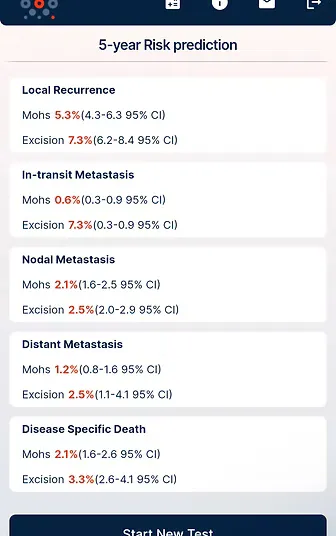
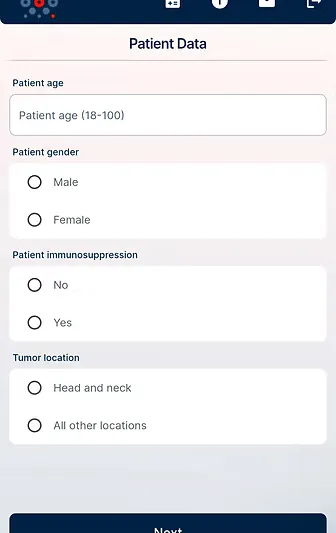
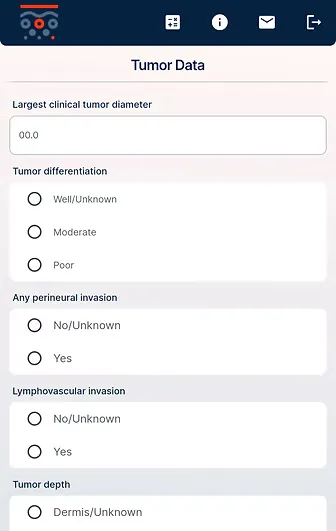
Five-year risk for each treatment path in the riSCC app
1 / 3
The challenge
A strong model is useless if it does not fit into a 15-minute visit.
The riSCC model was published in the Journal of the American Academy of Dermatology in 2025 (PMID 40024391). It needs 10 clinical inputs and returns risk for 5 outcomes across 3 treatment options. The client had never built software before. They needed a partner to explain each step, give a realistic estimate and keep the budget.
-
10
clinical inputs on two short screens
-
15
results at once: 5 outcomes × 3 treatment paths, each with a 95% confidence interval
-
0
patient records stored
-
3
platforms: iOS, Android, web
How we delivered it.
-
Plain-language estimate.
Before any code, we explained the options (where the model runs, what is stored, how apps reach the stores) and gave a fixed timeline and budget.
-
Design for time pressure.
We tested two layouts and kept the one where all results update on one screen as the doctor types.
-
Privacy by design.
The first version stores nothing. Data lives only on the screen and is gone when the doctor closes it, so no patient data ever leaves the visit.
-
Model kept in its original language.
The statistical model stays in R, in a container behind a secure API. When researchers update the model, the app does not need a new release.
-
Published and automated.
Free apps in the App Store and Google Play, a web version, and automatic deployment from GitHub.
The result.
- Delivered on time and under budget (in the client's own words).
- Free for medical professionals worldwide (pro bono).
- An architecture that can grow: optional sign-in and anonymous result history for long-term studies were designed and are ready if the research team needs them.
Have a model, a study or a clinical tool that should be an app?
We will help you scope it, keep patient data safe and get it into the hands of clinicians.
Talk to us about your MedTech projectMore case studies
-
Platform migration · Mobile + Web
60,000 users moved to a new platform. Nobody had to stop.
F-Pro migration case study -
Field Service Management · Web + Mobile
One system for every service visit, in three countries.
Velis360 Inspections case study